Tour a few preschools and you’ll collect a handful of names — Montessori, Reggio Emilia, Forest School — each offered as a kind of promise. It’s easy to feel you’re supposed to pick a team, and to worry you’ll pick wrong.
Here’s a calmer way in. This article explains what each of these approaches actually is, what they genuinely share, and why the most useful question isn’t “which one is best?” but “how thoughtfully does this school use them?” Because in the early years, the label on the door matters far less than what actually happens in the room.
What is Montessori?
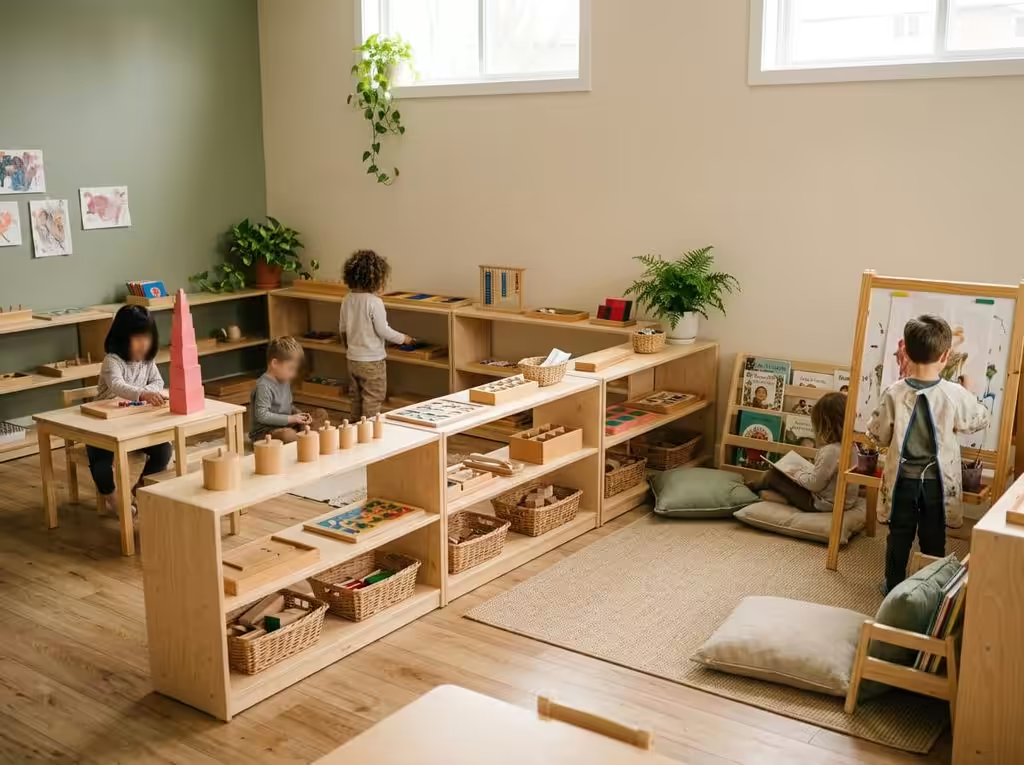
Montessori, developed by Dr Maria Montessori over a century ago, is a child-centred approach built around independence. Children work in a carefully prepared environment, choosing from specially designed, hands-on materials and working at their own pace during long, uninterrupted stretches. Classrooms usually mix ages across a three-year span, so younger children learn from older ones and older children consolidate by helping. The adult’s job is less to instruct than to observe and gently guide. The aim is a capable, self-directed child who genuinely wants to learn.
What is Reggio Emilia?
The Reggio Emilia approach began in the town of the same name in northern Italy just after the Second World War. It sees the child as capable and curious — a protagonist in their own learning rather than an empty vessel. Learning is largely project-based, following the children’s real questions, and the classroom environment is treated so seriously it’s often called “the third teacher.” A hallmark is documentation: teachers record children’s thinking and revisit it with them. Underlying it all is the idea that children express themselves in a “hundred languages” — talk, drawing, building, movement, music — and that all of them count.
What is Forest School?
Forest School isn’t a single lesson but a long-term, regular programme of sessions in a woodland or natural setting. It’s child-led and hands-on, and it deliberately offers children supported risk — climbing, tools, fire in older settings — as a way to build confidence, resilience and good judgement. According to the Forest School Association, it aims at the holistic development of confident, independent, creative learners through a genuine, ongoing relationship with nature. It’s less a subject than a way of being outdoors, regularly, over time.
In the early years, the label on the door matters far less than what actually happens in the room.
What They Actually Share
Line them up and the family resemblance is striking. All three trust the child as an active, capable learner rather than a passive recipient. All three favour learning by doing over drilling. All three lean on rich environments, real materials and the child’s own curiosity, and all three cast the adult as a guide rather than a lecturer. This isn’t a coincidence — it’s what the wider evidence on early learning keeps pointing to: young children learn best through play, exploration and inquiry, not worksheets.
Why a Thoughtful Blend Beats Loyalty to One
Here’s the quiet truth that marketing tends to skip: no single method has a monopoly on good early education. Montessori’s independence, Reggio’s project-led curiosity, and Forest School’s outdoor resilience aren’t rivals — they answer different parts of the same child. A dogmatic “pure” version of any one approach can end up rigid; a shallow “we do a bit of everything” can end up meaning nothing. What you want is a school that understands each approach well enough to blend them on purpose, and can tell you why it does what it does.
How We Blend Approaches at Sun Preschool
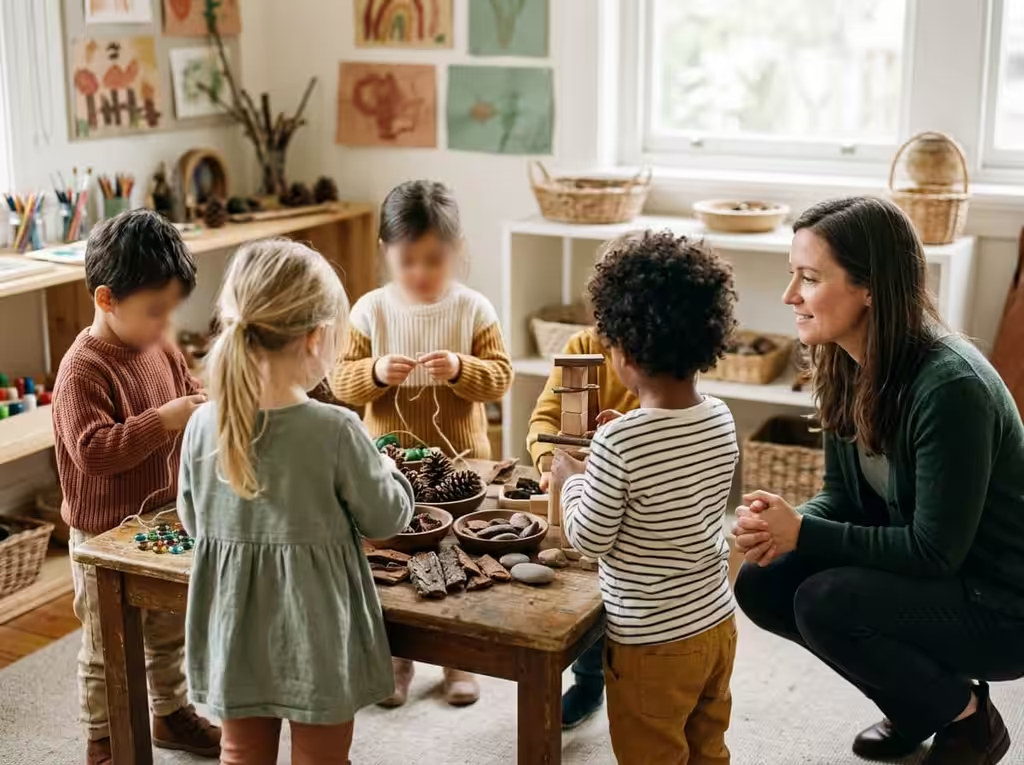
At Sun Preschool we don’t fly a single flag, because children aren’t a single thing. Our foundation rests on the national early-years curriculum framework, enriched by full bilingual immersion. With a dedicated English teacher co-leading the classroom all day, language acquisition happens naturally through play, songs, and daily routines rather than isolated lessons. We layer this with hands-on science and math, alongside intentional practices drawn from Montessori, Reggio Emilia, and Forest School. The point isn’t to collect methods; it’s to take what each does best — independence, curiosity-led projects, real time outdoors — and fold them into one coherent day.
We’re always happy to walk a parent through exactly how, and why. It’s the kind of thing that makes far more sense standing in the classroom than reading about it.
The Takeaway: Ask How, Not Just Which
Montessori, Reggio Emilia and Forest School are all genuinely good traditions, and you don’t have to crown one. The better question, on any school tour, is how well the school understands the approaches it names and how thoughtfully it brings them together for real children. Judge the room, not the brochure.
If you’d like to see a considered blend in practice, we’d love to show you around Sun Preschool.
References & Further Reading
- American Montessori Society — Introduction to Montessori
- North American Reggio Emilia Alliance — The Fundamentals of the Reggio Emilia Approach
- Forest School Association — What is Forest School?
- National Association for the Education of Young Children (NAEYC) — The Power of Playful Learning in the Early Childhood Setting
Frequently asked questions
Is one method actually better than the others?
No — and be a little wary of anyone who insists otherwise. Montessori, Reggio Emilia and Forest School each do something valuable, and they overlap more than they compete. What matters far more than the label is how well a particular school understands and applies whatever it uses. A thoughtful blend, done with real understanding, tends to serve a child better than rigid loyalty to one name.
Does my child need a “pure” Montessori or Reggio school?
Not necessarily. A purist setting can be excellent, but “pure” is no guarantee of quality on its own, and a rigid version can become inflexible. Many strong preschools deliberately combine approaches. Look at how the day actually runs and how the staff talk about their choices, rather than chasing a single trademarked label.
Do these approaches teach reading and maths, or is it all play?
They absolutely build early literacy and numeracy — just not through worksheets. In these traditions children reach reading, writing and mathematical thinking through hands-on materials, real projects and play, which is exactly how young children learn most deeply. Play and learning aren’t opposites here; the play *is* the learning.