“What did you learn at school today?” “I played.” It’s an answer that leaves plenty of parents wondering: if the whole day is play, where does the learning happen? In play-based learning, children think, talk and solve problems while doing something that genuinely matters to them. The teacher prepares the space and provides support to help that learning happen.
“Play” here doesn’t mean a day without a plan. There’s a clear structure, one that leaves room for children’s own decisions while an adult watches closely. Plan-do-review is a daily cycle that helps a child decide what they want to do, have a go at it, and then think back over what happened.
Which Skills Are at Work When Children Play?
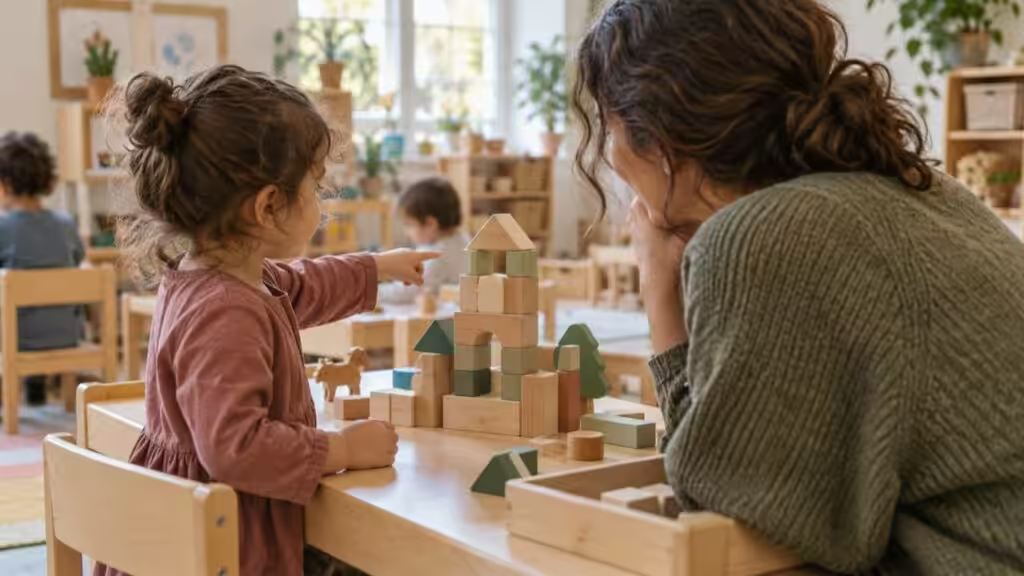
Picture a child building a bridge out of blocks. They compare the lengths of the pieces, move the supports around, and when the bridge collapses, they try something else. When a friend joins in, they also have to share the blocks and agree on what to do next.
A single game like this touches on a lot at once:
- Language: explaining a plan and saying what they need.
- Maths: noticing length, quantity, order and how things relate.
- Thinking: predicting, trying, and comparing what happened.
- Getting along: sharing space and sorting out disagreements.
- Movement: placing materials, balancing them and keeping them steady.
Not every game works on all of these equally. The teacher’s job isn’t to say “play teaches everything” and leave it there. It’s to see what the child is actually doing and work out which next step they might need help with.
What Is Plan-Do-Review?
HighScope’s preschool curriculum builds time into the daily routine for children to decide on something to do, carry out their ideas, and reflect on what they did. Each of the three parts is pitched to the child’s age.
Plan: the child says where they want to work, with what, and if possible with whom. It doesn’t need to be a speech. A younger child might simply point to an object; an older one might say, “I’m going to build a house for the animals in the block corner.”
Do: the child tries out their idea. An adult joins in when needed but doesn’t finish the building for them. If the materials run out or the idea changes, new decisions can be made along the way.
Review: the child remembers what they did. Questions like “What did you try?” or “What changed after that?” take them back to the experience. Talking, drawing, or showing the thing they used can all be part of this conversation.
Review isn’t a test of whether they succeeded. It gives the child space to notice their own way of thinking. A plan that changed halfway through is just as worth talking about.
What Does Water Play Look Like in This Cycle?
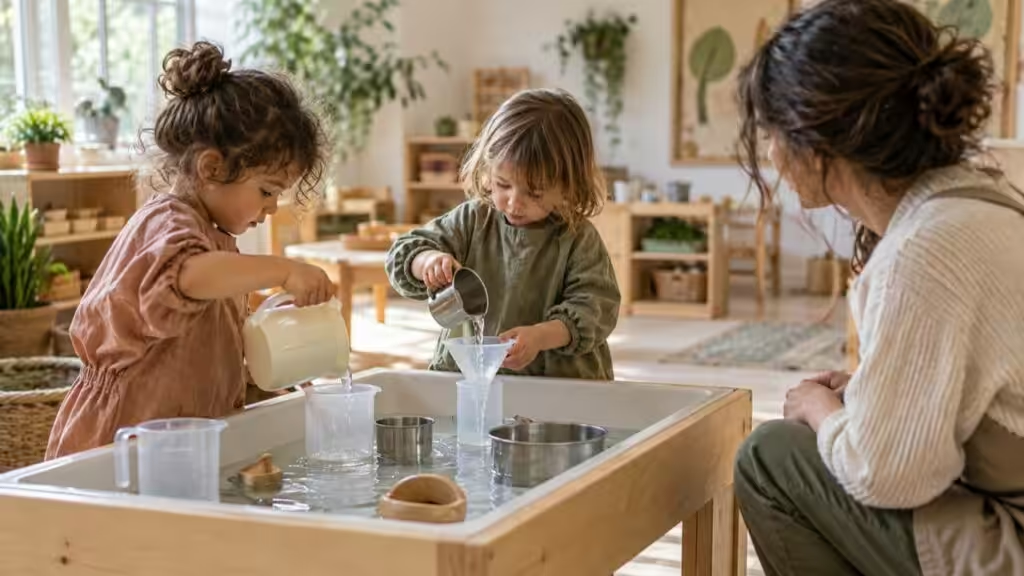
Sun’s parent handbook uses water play as an example of measuring, sharing, predicting and negotiating. Let’s imagine an example morning to see how this works.
A child starts by announcing, “I’m going to fill the big tub.” After tipping the small cup in several times, they notice the big tub is full. When a friend wants the same cup, an adult helps them talk through taking turns. When the tub overflows and the child says, “I need to put less in,” that’s a new experiment.
In the conversation at the end, a question like “What did you think at the start, and what happened?” helps the child reflect on what they did. The teacher can use words for quantity along the way and listen to the child’s own explanation. That way, the learning inside a game with water becomes visible in the child’s own words too.
When Does the Teacher Step In?
The teacher keeps children safe, makes sure materials are within reach, and watches. If a child keeps returning to exactly the same thing, the teacher might ask a question or offer another material. If two children can’t agree, the teacher helps them talk it through. And when a child is finding their own way, the teacher can simply wait.
Too many questions can sometimes break up the play. Rather than constantly quizzing (“What colour is this? How many are there? What’s it called?”), sharing an observation such as “You’ve used that piece at the bottom” can open up a conversation. And any questions should come from real curiosity.
The learning in play shows not only in what a child does, but in how they can think about what they did.
How the Day Is Structured at Sun Preschool
In Sun’s curriculum framework, plan-do-review is part of daily centre time. Science and maths activities, outdoor experiences and English throughout the day are all planned alongside it. How children plan and remember changes with their age.
You can read about the hands-on science side of GEMS in our guide to GEMS, and about how different approaches show up in everyday practice in our article on teaching methods. To understand a school’s approach, look less at the name of the method and more at how much room children have to make their own decisions.
How You Can Support It at Home
Before a game, ask “What would you like to do?”, but don’t turn the answer into a schedule. Then provide the materials and time they need. Once the game is over, you can chat about a drawing or an object: “What happened here?”
You don’t need to run every game like a lesson. Listening to your child’s ideas and coming back to one of their experiments can be enough. When their interest shifts, talk about that too: “First you wanted a tower, then you built a road. How did you decide?” For an outdoor starting point, our guide to gardening with children has ideas to try together.
If you’d like to talk in person about how your child could learn through play, you can arrange a visit.
References & Further Reading
Frequently asked questions
Will a child who learns through play struggle at primary school?
Getting ready for school isn’t only about filling in worksheets. Listening, planning, asking for help and sticking with a task are all part of being ready. Our guide to school readiness explains these skills.
What if my child always chooses the same game?
Repetition can help a child go deeper into an idea. The teacher watches how much the game is changing and what the child needs. A new material or a small shared experience can widen their options.
If they don’t finish their plan, does that count as failing?
No. Working out why an idea changed is learning too. Running out of materials, a new curiosity or a friend’s suggestion can all change a plan. The conversation at the end helps make sense of those decisions.