“Why do I always have to wait?” “If I really love a toy, can it be mine forever?” A four-year-old can ask surprisingly difficult questions about everyday life. Philosophy for children is simply a way of thinking those questions through together. It isn’t about learning the names of famous philosophers, or finding the one right answer. It’s about saying what you think, explaining why, and listening to someone else.
Sometimes the most helpful thing an adult can do is not answer straight away. A simple “What do you think?” gives your child’s own idea some room. And not every “why?” needs to turn into a long discussion.

How Does a Philosophy Circle Get Started?
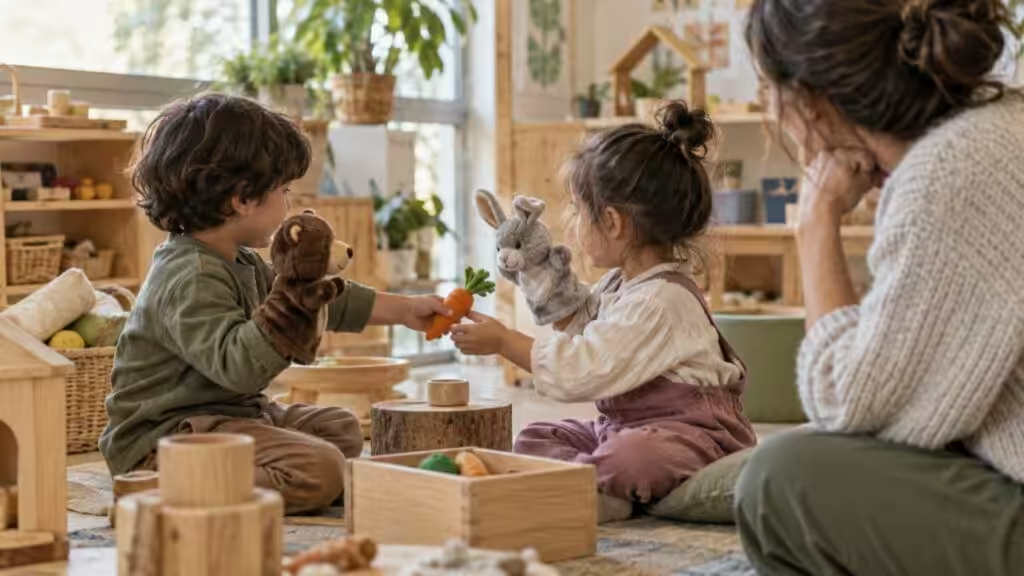
It might begin with a picture book, a puppet or a short story. Say two characters both want the same toy. The adult asks, “What would be fair here?” and the children start offering ideas.
One child says, “Whoever found it first gets to use it.” Another thinks, “But they should share with their friend too.” Rather than steering the children towards their own answer, the adult helps them make their thinking clearer: “Why does finding it first matter?” “What changes if you take turns?” Questions are kept short and matched to the children’s age and interests.
In a circle like this, just listening counts as taking part. Everyone is offered a turn to speak, but nobody is expected to talk for as long as everyone else. Drawing something or showing it with a puppet can help a child share their ideas too.
How Do You Talk About Big Questions With Little Children?
Start from something your child knows, not an abstract definition. Instead of “What is friendship?”, try “If your friend plays with someone else today, are they still your friend?” If you’re talking about courage, you might look at a story and ask, “Can you be scared and brave at the same time?”
Don’t rush to correct your child’s idea. First make sure you understand what they mean: “You said a child who plays alone can’t be happy. Is that always, or just sometimes?” They may come up with a counter-example themselves, or change their mind.
A conversation that suits a young child can be a short one. If the children are starting to fidget or finding it hard to stay on the subject, stop there. Coming back to a question another day doesn’t mean the first conversation was unfinished.
How Do Children Learn to Listen When They Disagree?
An adult can help build a few simple habits:
- Letting someone finish before you speak.
- Disagreeing with an idea without hurting the person who said it.
- Using “I think…” and “because…” to explain your own view.
- Asking someone to explain again when you don’t understand.
- Allowing yourself to change your mind.
None of this happens perfectly on its own. Children will interrupt, repeat the same idea, or tell a very long story of their own. The adult calmly reminds everyone how the circle works, and doesn’t let the conversation turn into a contest.
What Skills Can Children Practise?
A philosophy circle gives children a chance to practise listening, asking questions, giving reasons and noticing that other people see things differently. It’s fair to describe those as the aims of the activity. Promising that every child’s attention or empathy will improve by a certain amount is a different claim altogether.
The research doesn’t all point the same way. In the Education Endowment Foundation’s large-scale trial in primary schools, children who took part made no extra progress in reading or maths, and no difference showed up in the social and communication measures used; teachers’ own views were more positive. That study was also with primary school children, not preschoolers.
So it wouldn’t be honest to promise definite academic gains for a four-year-old. When you’re judging an activity like this, look instead at whether the children join in comfortably, how the adult makes room for their ideas, and how the conversation connects to their everyday relationships. If your child is interested in games with rules, we also look at getting started with preschool chess.
Making room for a child’s question is a way of taking their thinking seriously.
Philosophy for Children at Sun Preschool
At Sun, our four- and five-year-old groups have philosophy circles led by the school psychologist. These sessions are held in Turkish, and their purpose is to give children a space where they can say what they think and feel with confidence.
A picture book or a question linked to the class theme might start the conversation. The sessions sit alongside everything children experience through everyday play and friendships. Our guide to teaching methods and our article on what early education really does for a child describe the wider approach behind our programme.
A Conversation to Try at Home
When you’re reading together, pause at the moment a character makes a decision: “What else could they have done?” Listen to your child’s answer. Then you can offer your own idea as just one more possibility: “I wondered if they could have asked for help.”
One of these questions is plenty: “Is sharing always easy?” “Can you be friends with someone who doesn’t like the same games?” “When we make a mistake, how can we put it right?” Don’t turn your child’s answer into a lesson. Just enjoy thinking it through together. For an everyday experience to talk about together, you could explore growing plants with your child.
If you’d like to talk about your child’s questions and what the programme looks like for their age group, you can arrange a visit. We’d be glad to welcome you.
References & Further Reading
- Education Endowment Foundation — Philosophy for Children: a large-scale evaluation in primary schools.
- NAEYC — Listen, talk, answer: supporting your child’s learning through everyday conversation.
Frequently asked questions
Isn’t four too young for philosophy?
It would be too young for the abstract kind of philosophy adults study. But talking through the questions that come out of children’s own experiences can be shaped to suit their age. Keeping it short and concrete is what matters.
What if my child gives the wrong answer? Won’t anyone correct them?
A philosophical question can have more than one well-reasoned answer. If a child gets a plain fact wrong, that can be explained simply. Understanding a child’s idea is not the same as treating everything they say as right.
Is this a kind of therapy?
No. It’s a group activity for thinking and talking together. If a child needs individual support, that calls for a separate assessment and the right kind of help.