
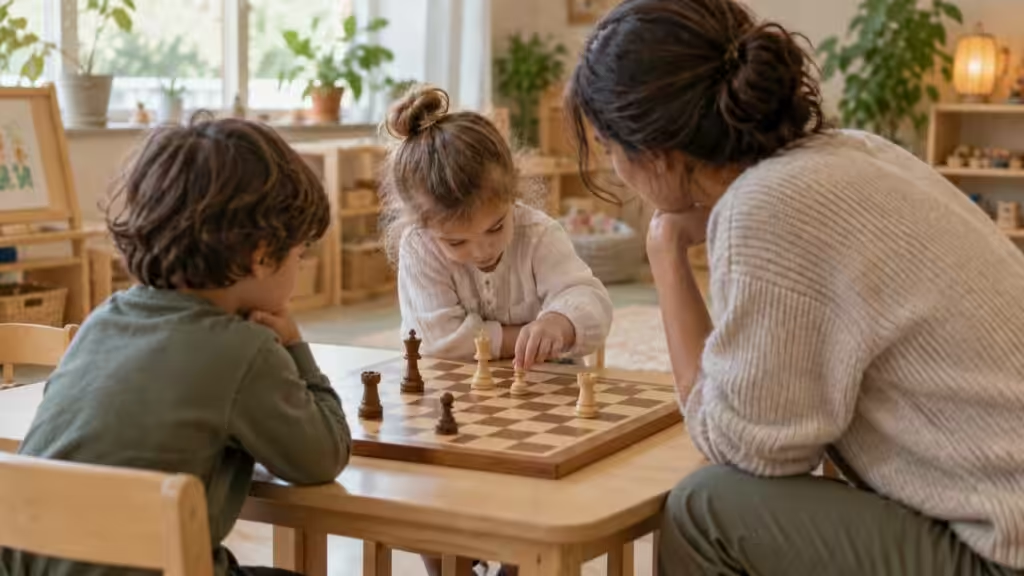
“Can a four-year-old learn chess?” Some children are drawn to the pieces and to games with rules; for others, it just doesn’t appeal yet. At this age, a good start means getting to know the pieces, trying out a few simple rules and taking turns, well before playing a whole game.
Avoid treating chess as an intelligence test. A day when your child forgets how a piece moves, or wants to get up and leave the game, tells you nothing about their future abilities. How the lesson is adapted for your child often tells you more than the age they start.
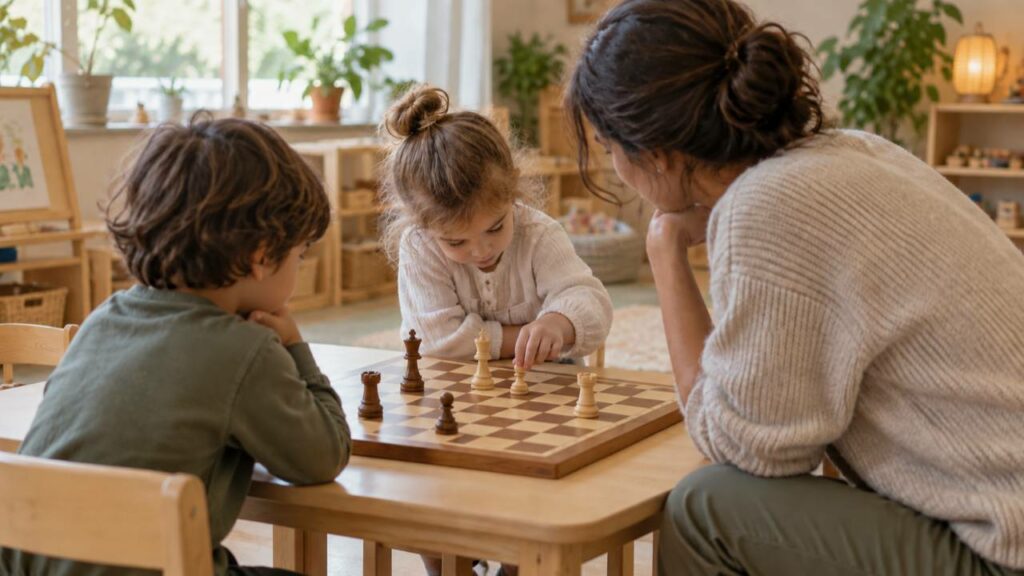
What Does Chess Look Like at Four?
Instead of introducing every piece at once, a teacher can start with just one. Noticing the squares, showing where a piece can go and trying a short challenge is enough. A game with the rook might simply be about discovering that it moves in straight lines.
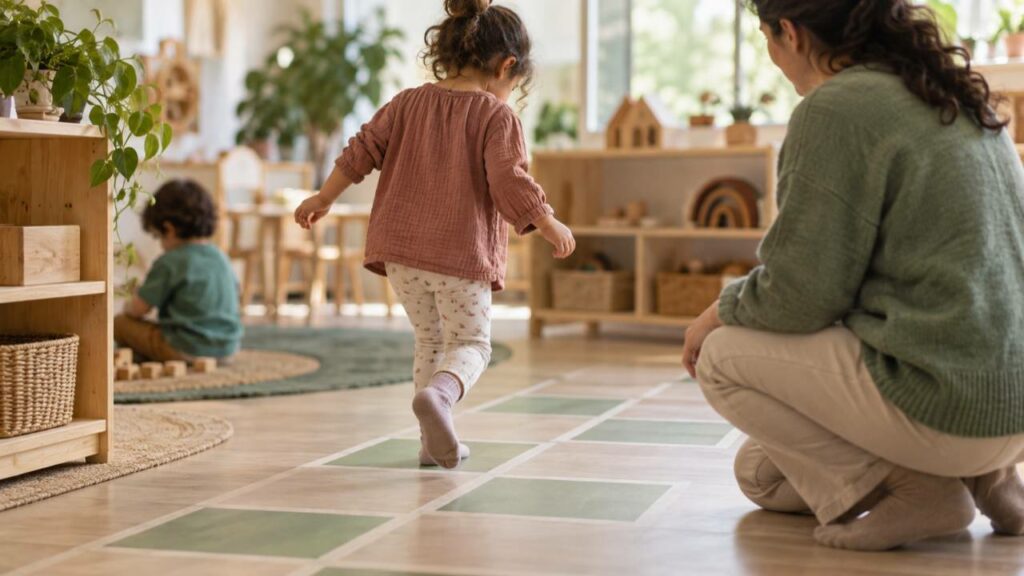
Movement games away from the board help too. Walking across squares on the floor, stepping forwards and sideways, or tracing a path one step at a time lets children feel the idea with their whole body. Children can then explore the same idea on the chessboard.
Every teacher does this a little differently. When you visit, ask for an example: “What exactly do the four-year-olds do in their first lessons?” Try to find out how the children join in, rather than how many piece names they’ve memorised.
Which Skills Can Children Practise Through Chess?
As a game with rules, chess gives children a chance to:
- Stop and look at the options before making a move.
- Wait while a friend takes their turn.
- Remember how a piece is allowed to move.
- See what happened and try a different way.
- Keep going, with an adult’s help, when things don’t go their way.
These are skills children can work on during the lesson. That doesn’t mean chess will transform everyday life or school results on its own. Other board games, movement and playing together can give children the same practice.
Harvard’s Center on the Developing Child has an activities guide on executive function that suggests a range of games for three- to five-year-olds involving rules, remembering and self-control. At this age, chess is neither the only route nor a necessary one. For other ways to explore thinking through conversation and practice, see philosophy for children and screen-free coding.
Does Chess Really Make Children Cleverer?
Be wary of any claim that a single activity brings guaranteed gains across the board. Getting better at chess isn’t evidence of getting better at other subjects to the same degree.
The Education Endowment Foundation’s evaluation of chess in primary schools found no evidence of an impact on attainment. That study wasn’t about four-year-olds, but it still gives no basis for promises like “chess guarantees success in maths”.
Your child enjoying the lesson, following a rule a bit better, or taking an interest in a friend’s move are real, concrete things you can see. The activity doesn’t need a grand promise about the future to be worthwhile.
What Does a Good Lesson Look Like?
The teacher gives short, clear instructions and never makes a mistake feel shameful. Rather than keeping children sitting at the board, they may use movement and hands-on games suited to the age group. The teacher talks about thinking and trying things out as much as winning.
Questions you might ask: What happens when a child forgets a rule? What can a child do if they don’t want to join in? Are the children trying to knock each other out, or exploring a challenge? How do the length of the lesson and the materials change with age?
A child sitting quietly isn’t, by itself, a sign that the activity suits them. Curiosity, joining in and being able to get help when they need it matter too. When considering the school’s wider approach, our guide to preschool teaching methods may help.
At four, the first aim of chess may not be to make a strong player, but to spark curiosity about the game.
Chess at Sun Preschool
Chess is one of Sun Preschool’s specialist subjects. Since the 2026–2027 school year, lessons have run in collaboration with the Istanbul Chess Association (İstanbul Satranç Derneği, İSD), which arranges our chess teacher, and they take place weekly. Read more in our article on chess lessons with the Istanbul Chess Association. When you meet us, you can ask what children in your child’s age group do in lessons and which pieces and challenges they start with.
A specialist lesson sits alongside everyday play and movement; it isn’t a replacement for them. There’s no need to turn a child’s whole school day into competitions or table work. Our guide to play-based learning and our curriculum describe that wider picture.
How Can You Start at Home?
If your child is curious, ask their teacher for one short game to try. Playing with a few pieces, for as long as their interest lasts, is plenty. Don’t try to teach all the rules straight away.
If they’re upset when they lose, don’t brush the feeling aside. You can try again together or take a break. Rather than always losing on purpose, try small challenges you solve together; they can make the start feel easier.
If you’d like to talk about your child’s interests and our specialist lessons, you can arrange a visit.
References & Further Reading
- Harvard University Center on the Developing Child — Activities guide: enhancing and practising executive function skills, with play ideas by age.
- Education Endowment Foundation — Chess in primary schools: an evaluation of chess’s impact on attainment.
Frequently asked questions
Can my child start before they know all the pieces?
Yes. An age-appropriate activity can start with a single piece or a single rule. There’s no need to present the whole game at once; ask the teacher how they build it up step by step.
What if my child isn’t interested in chess? Should we keep pushing?
Don’t push. Other games with rules offer similar chances to practise, and they may well become curious again later.
Does a four-year-old need to play in tournaments?
No. Getting to know the game and having short, enjoyable experiences is a perfectly good goal. Whether to compete is a separate decision, based on what your child wants and whether it suits their stage of development.