
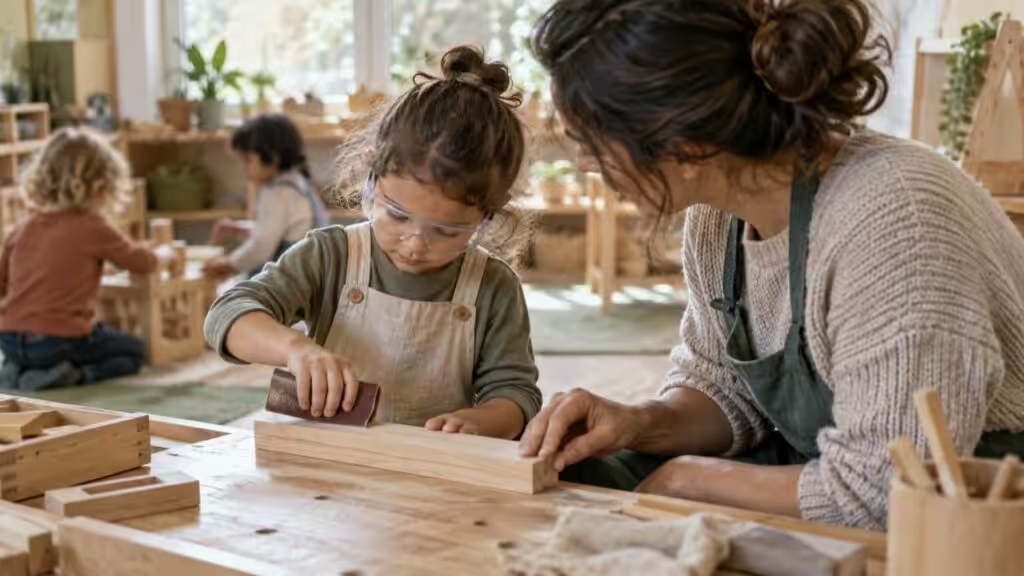
“Would you really give a four-year-old a real hammer?” It’s a completely understandable question. Working with real tools needs the right setting, materials adapted to the child, and close adult supervision. It isn’t a decision made on age alone, or on how keen a child is.
The point of a woodwork session isn’t to hurry a child into finishing a product. Sketching an idea, comparing pieces, preparing a surface and working on it with an adult’s support can all be meaningful experiences. Safety isn’t separate from the work; it’s built into it.
What Do Children Actually Do at the Woodwork Bench?
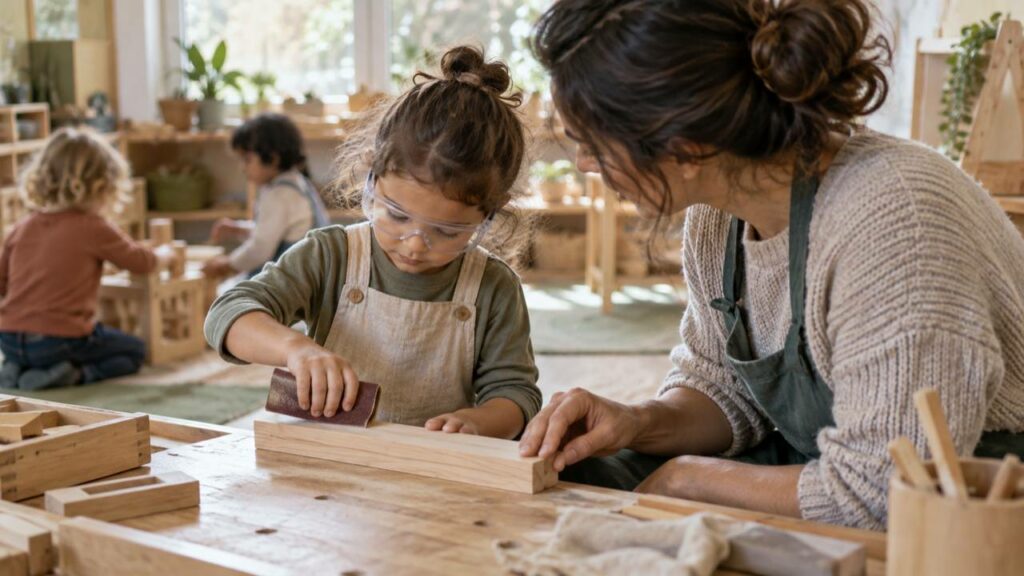
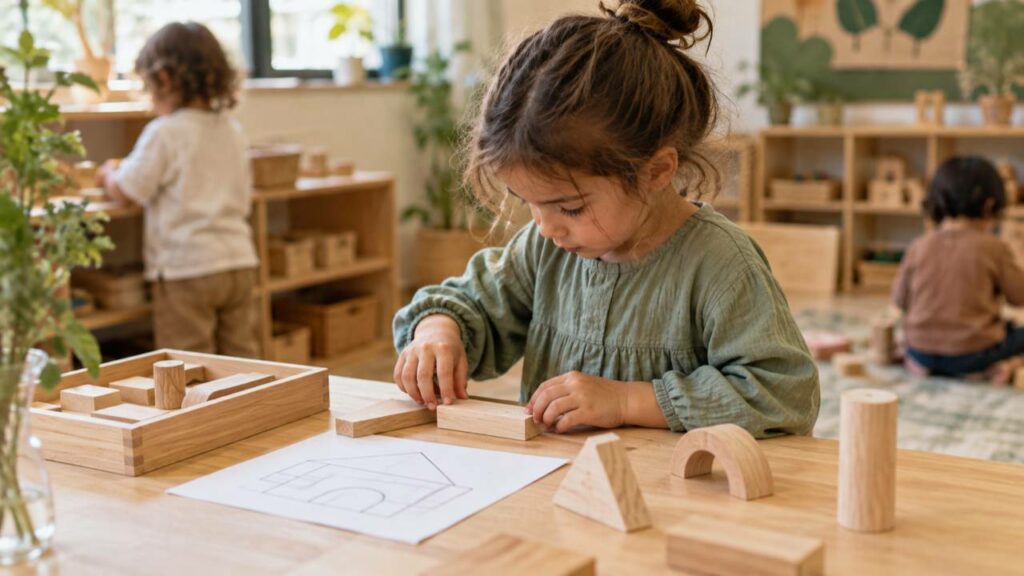
A child’s first experience doesn’t have to be hammering in a nail. They can start by getting to know the feel and shape of the wood, laying pieces side by side, sanding, or drawing a design. The adult watches how the child is joining in and which jobs they’re ready for.
Take a picture frame. The child compares the lengths of the pieces, looks at how the corners will join and decides how to decorate it. Some steps may be prepared by an adult. Children can make a meaningful contribution without doing every stage alone.
NAEYC’s article on the wonder of woodwork describes the opportunities for design, creativity and problem-solving when educators supervise. But one good example doesn’t mean every school has the same safety arrangements.
How Can You Tell If the Set-Up Is Safe?
Tools shouldn’t be left lying around. The work area should be kept apart from other children moving about, and an adult should assess the materials and the task. A working height that suits the child, and a stable set-up, matter too.
Ask concrete questions when you visit:
- Which tools are used, at what age, and for which jobs?
- How are children shown how to use them safely?
- How closely does an adult work alongside them?
- How are the materials checked?
- How do you decide on eye protection and any other precautions?
- What happens when a child loses concentration or wants to stop?
- Where are the tools kept when they’re not in use?
Hearing about, and seeing, an established way of working tells you far more than “We’re very careful.” And you don’t need to learn tool technique from an article and try to recreate the activity at home; don’t attempt it without the support of a suitably trained educator.
What’s the Difference Between Risk and Danger?
A child trying something in a controlled way isn’t the same as a child being exposed to danger no one can manage. It’s the adult who judges safety; that responsibility isn’t handed to the child just because they want to have a go.
If a task isn’t right for a child, it can be changed: a simpler material, a piece prepared in advance, or just the design stage. A child who doesn’t want to use tools can still take a real part by drawing and arranging the pieces.
“There’s no risk at all” isn’t a realistic claim. A good explanation tells you which precaution matches which risk, and when the adult steps in. What a child can manage can also change over time and from one setting to another.
How Do Hands and Thinking Work Together?
Positioning a piece calls for hand–eye coordination. The child adjusts their movement, feels the surface change and checks what they’ve done. It gives them a much wider range of ways to use their hands than a single handwriting exercise.
Design takes thinking too. If the pieces don’t fit, the child can try a different arrangement. An adult can help them notice with a question like “Why has this corner been left open?” Quickly fixing the piece for them can take away the chance to learn.
No single workshop will develop every hand skill. Play dough, drawing, cutting and everyday jobs all help as well. Our guide to primary school readiness looks at hand skills in the bigger picture. Our screen-free coding guide offers another example of trying an idea and revising it.
The decisions a child makes along the way matter as much as the thing they make.
Hands-On Learning at Sun Preschool
Woodworking is not currently part of Sun Preschool’s programme. Children design and make things in the maker studio, explore materials through art, plant seeds in the garden and pretend to cook in the mud kitchen. On a visit, you can ask how these hands-on activities fit into the day for your child’s age group.
These activities sit alongside everyday play and time in nature, without pressure to compete. Our guide to teaching approaches and our guide to learning outdoors explain where hands-on work fits in our programme. For the national framework around these activities, see our guide to Türkiye’s preschool curriculum.
How to Talk About What They Bring Home
As well as “That looks lovely and neat,” try asking “How did you think of that?” Listen to which pieces they chose and whether they changed their mind along the way. An unfinished piece is worth talking about too.
Don’t compare your child’s work with another child’s. A perfect-looking photo doesn’t tell you, on its own, how much help they had or what they learnt. Ask the teacher to describe a moment from the making process.
If you’d like to talk about the hands-on activities your child could take part in, you can arrange a visit to Sun Preschool.
References & Further Reading
- NAEYC, Pete Moorhouse — The wonder of woodwork: woodwork, creativity and problem-solving in the early years.
Frequently asked questions
Can every four-year-old use a hammer?
No. Age alone isn’t the measure. The task, how the child is joining in and the set-up the educator has put in place are all considered together. Some children start with other stages.
Do the children use power tools?
Early-years woodwork uses real hand tools with close adult supervision. Power tools are not for children to use. Ask the school which hand tools children use, for which tasks, and how adults supervise them.
Should we try woodwork at home too?
There’s no need. Please don’t try to pick up tool techniques from an article and recreate the activity at home without support from a suitably trained educator. Talking with your child about what they bring home, and asking “How did you think of that?”, is a valuable way to join in.
My child is hesitant. Should we encourage them to have a go?
Don’t push. Watching, drawing or choosing pieces all count as taking part. Give their own curiosity room to grow in a safe setting.