
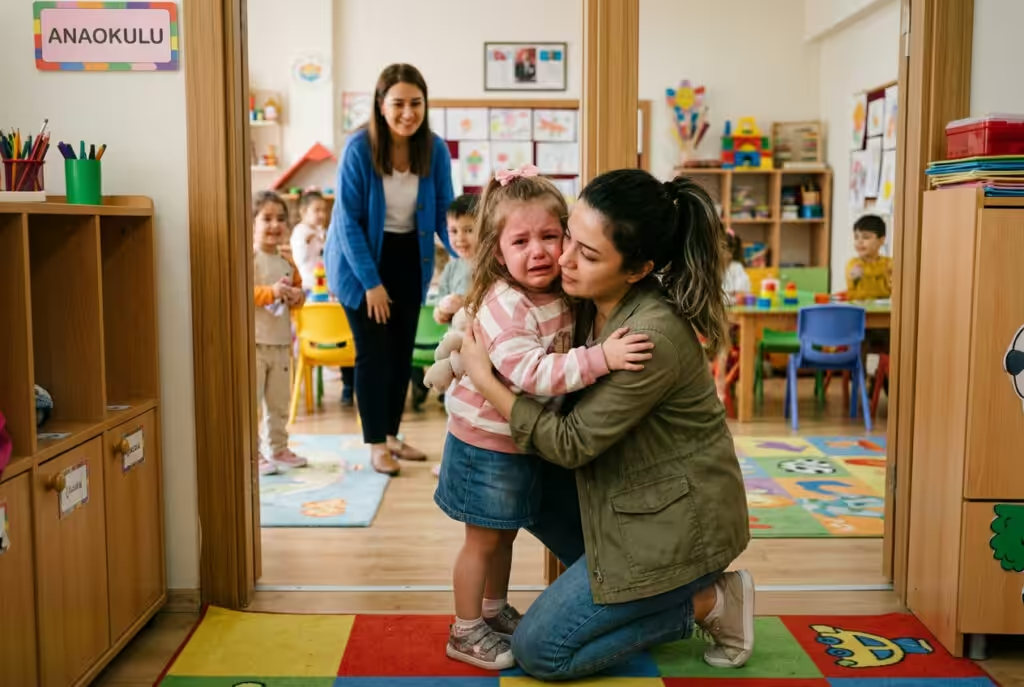
You’re at the school gate, your child is in tears and clinging to you, and walking away feels like the hardest thing in the world. You go off to work with a knot in your stomach, and half your mind stays behind all day: are they still crying?
If this is you right now, two things are worth holding on to. You’re far from alone — and it doesn’t mean anything has gone wrong. Settling into preschool is a stretch of road nearly every child and every family travels. This article is about why it happens, roughly how long it tends to last, and what you can do to make the whole thing gentler, for your child and for you.
First Things First: Crying Isn’t a Problem — It’s a Good Sign
When your child cries as you leave, they’re actually telling you something lovely: they’re securely attached to you. Separation anxiety is a healthy, expected part of growing up. Your child has developed far enough to notice that the person they love and rely on is leaving — and being upset about that is exactly what you’d hope to see.
So try not to read those tears as failure, or as proof your child doesn’t like school. Most children settle within minutes of the door closing and get on with their day. The crying at goodbye usually says very little about the hours that follow.
Tears at the door are usually a sign of secure attachment — not a sign that something’s wrong.
How Long Does Settling In Usually Take?
Every child finds their own pace — there’s no set timetable. Some are at ease within a few days; for others it stretches over a few weeks. The first couple of weeks are normally the hardest, and bit by bit the tears give way to curiosity and then to fun.
The thing to expect is that it won’t move in a straight line. Your child might sail through one week and struggle the next. An illness, a spell away over the holidays, or a change at home can all bring a wobble. That’s normal too, and not a reason to worry.
For Parents: What Actually Makes Settling In Easier
The biggest difference you can make comes from how you handle it. A few things that genuinely help:
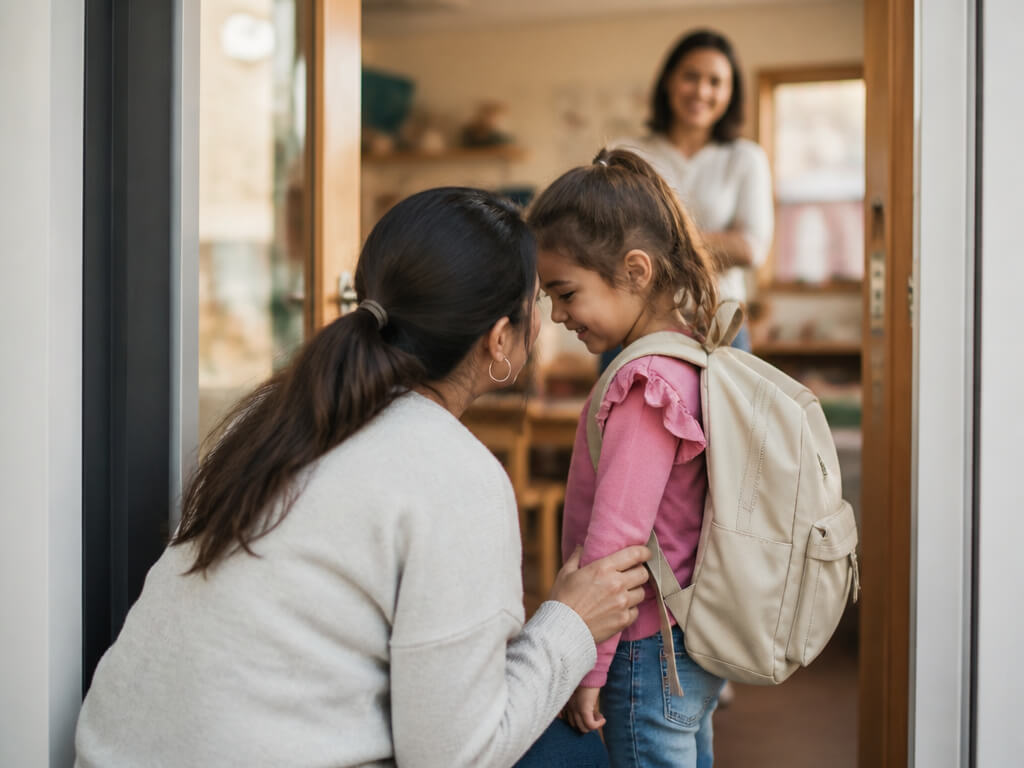
Keep goodbyes short and warm. A long, lingering farewell doesn’t calm a child down — it usually winds them up. A quick, affectionate send-off — a kiss, a little handshake that’s just yours, a clear “I’ll be back to get you this afternoon” — gives them both the love and the certainty they need.
Never sneak off. Slipping away while they’re not looking feels like the easy option, but it chips away at their trust and makes the next goodbye worse. Your child needs to know you’re going, and to trust that you’ll come back.
Stay calm yourself. Children read their parents like a book. If you’re anxious and hesitant, they take it as evidence there’s something here to be scared of. Your steadiness is the most reassuring thing in the room.
A little piece of home can help. A small toy or a familiar object from the house gives some children a comforting bridge into the day.
Talk about school warmly at home. Chatting about the fun bits of their day, and mentioning their teacher and friends with warmth, helps your child build a happy picture of the place.
Turn up when you said you would. Being there on time, every time, backs up the one thing that matters most to them: Mum or Dad always comes back. Nothing settles separation anxiety faster than that trust.
Give it time. Settling in isn’t a one-day job. Patience and consistency beat rushing it, every time.
How a Good Preschool Helps a Child Settle
Settling in isn’t only down to you — the school shapes it just as much. A good one smooths the way in a few clear ways.
It eases children in gradually, stretching their day little by little so the change never lands all at once. It keeps a familiar, steady team of teachers, so your child has the same faces to bond with rather than a revolving door. It stays in close, open contact with you, so you can get on with your day knowing your child is fine. And above all, it’s warm and unhurried, and it lets each child move at their own speed.
There’s one thing here that’s easy to miss but makes all the difference: teacher continuity. A child bonds with a particular teacher — and it’s that teacher still being there afterwards that gives the bond its power. Where staff come and go, a child has to start building trust from scratch each time.
How We Handle Settling In at Sun Preschool
At Sun Preschool, we treat settling in as a journey each child takes at their own pace, with plenty of patience and warmth to lean on. We ease children in gradually, giving them room to get to know the school, their teacher, and their new surroundings a step at a time.
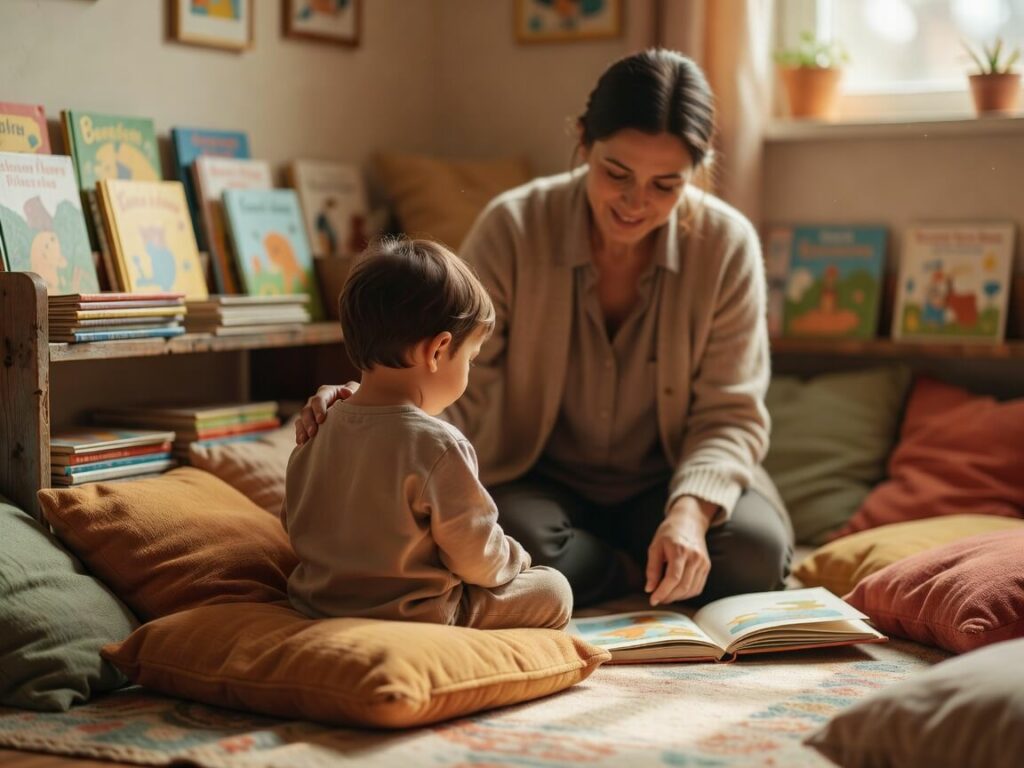
For us, the heart of it is emotional security — and the biggest source of that is a staff who stay. Many of our teachers have been with us for years, and our leadership has held steady over the long term, so the people your child bonds with are the same people who greet them month after month, and year after year. That kind of continuity means the faces your child comes to trust are still there tomorrow — one of the most valuable things a preschool can offer.
We treat staying in touch with you as part of the job, too. We keep up regular, open communication with our families through the day, so you always know how your child is doing — and can carry on with your own day with your mind at rest.
The Takeaway: Patience, Consistency, and Trust
Settling into preschool is an emotional shift — for your child and for you. The tears come with the territory, and they’re a sign of healthy attachment, not a problem to fix. Stay patient, steady, and calm, lean on the right school, and it almost always comes good in the end.
If it matters to you that your child settles somewhere warm and secure, at their own pace, we’d be glad to show you how we look after that at Sun Preschool. Get in touch to arrange a visit.
References & Further Reading
- American Academy of Pediatrics (HealthyChildren.org) — How to Ease Your Child’s Separation Anxiety
- ZERO TO THREE — Separation Anxiety
- Illinois Early Intervention Clearinghouse — Separation Anxiety and Attachment in Infants and Toddlers
Frequently asked questions
How do you help new children settle in?
Every new child follows a gradual settling-in program that we plan together with the family.
There is no one-size-fits-all schedule: we respect each child’s own rhythm and shape the process around their needs. Our teachers stay in close contact with you throughout this period, so that both your child and you can grow comfortable with school at your own pace, with confidence.
How will I know how my child’s day is going?
Through the parent app developed specially for our school, you can follow your child’s day in real time.
Once installed on your smartphone, the app gives you one-tap access to:
- Meal and nap tracking
- Daily development notes and teacher feedback
- Photos from the activities your child takes part in
- All school announcements
We believe deeply in family–school partnership and transparency — whenever anything is on your mind, our teachers and management are easy to reach.
How long should I wait outside the school after drop-off?
Usually it’s best not to linger. A warm, brief goodbye and a confident exit help your child settle faster than a long wait at the door, which tends to stretch out the hard part for both of you. Trust the teachers to comfort your child — and ask them to message you once your child has settled, which is often within minutes.
What should I do if my child regresses after a holiday or an illness?
Expect it, and try not to worry. A break in routine often brings a wobble, even after weeks of going well — it’s normal and temporary. Go back to the basics that worked before: the same short goodbye ritual, calm reassurance, and turning up exactly when you said you would. Within a few days most children find their rhythm again.
Is it normal for my child to cry at drop-off but be happy the rest of the day?
Completely normal. The tears at separation usually say very little about the hours that follow — most children calm within minutes and enjoy their day. If you’re unsure, ask the school how your child is doing after you leave; a good preschool will happily tell you.