If you are looking for early years education in Türkiye — particularly as an international parent — the terminology can quickly become confusing.
Preschool, nursery, day care and crèche are all commonly used in English. In Türkiye, you will also come across anaokulu, kreş and gündüz bakımevi. These words are sometimes used loosely in everyday conversation and even in advertising, which can make it difficult to understand what kind of setting you are actually looking at.
There are real differences between some of these terms, particularly within the Turkish education and child care systems. But there is also an important point to keep in mind: the name of a setting tells you what type of institution it is; it does not, by itself, tell you how good it is.
In this article, we explain the differences between preschool, nursery and day care, how the Turkish terms anaokulu, kreş and gündüz bakımevi fit into the picture, and what parents should actually compare when choosing an early years setting in Türkiye.
Preschool, Nursery and Day Care: What Do the Terms Mean?
In English, these terms do not have exactly the same meaning everywhere in the world.
Preschool generally refers to an early education setting for children in the years before primary school. Learning is usually planned around children’s social, emotional, physical, language and cognitive development, with play remaining a central part of the day.
Day care usually places more emphasis on providing safe and reliable care for children while their parents are at work or otherwise unavailable. Day care settings often operate for longer hours and may accept children from a younger age.
Nursery is less straightforward because its meaning varies considerably between countries. In some places, a nursery is essentially a preschool; elsewhere, it may provide both early education and full-day child care. The term crèche is also generally associated with the care of babies and younger children.
These categories therefore overlap. A high-quality day care centre can provide meaningful learning experiences, just as a good preschool must provide excellent care.
The distinction is not simply whether children are being “cared for” or “educated” — young children need both. What matters more is the institution’s purpose, educational structure, age group and the kind of experience it provides throughout the day.
What Do Anaokulu, Kreş and Gündüz Bakımevi Mean in Türkiye?
In Türkiye, these terms are more than simple translations of English words.
An anaokulu is a preschool education institution. Its primary purpose is early childhood education and development in the years before primary school.
Kreş and gündüz bakımevi, meanwhile, belong to a different regulatory framework and have traditionally been associated more closely with the care of younger children. In everyday Turkish, however, kreş is often used much more broadly to describe almost any setting attended by young children during the day.
This is one reason the terminology can be particularly confusing for international families.
There is also no perfect one-to-one translation between the Turkish and English systems. Depending on the context, an anaokulu might be described in English as a preschool, kindergarten or sometimes a nursery school.
Age rules can also change as regulations are updated. MEB amended its rules for private preschool institutions in 2025 to allow enrolment from the month a child completes 24 months, although that particular provision subsequently became subject to a court decision. For parents, the practical lesson is simple: if your child is at the younger end of preschool age, confirm the current admission rules directly with the institution.
At Sun, we use Sun Preschool in English because it most clearly communicates the educational nature of our school.
The name tells you what kind of institution you are looking at. It does not tell you the quality of the experience your child will have there.
The Label Matters Less Than What Happens Inside
Understanding the terminology is useful, but it should only be the beginning of your comparison.
Two institutions belonging to the same category can provide very different experiences for children.
One preschool may have experienced teachers who remain at the school for many years, thoughtfully planned classrooms, genuine outdoor space, a clear educational programme and small groups. Another institution carrying exactly the same anaokulu label may operate very differently.
The same is true of nurseries, day care centres and gündüz bakımevleri.
That is why parents should avoid using the category itself as a shortcut for quality. Instead, look at the factors that directly shape your child’s day: the teachers, group sizes, educational approach, relationships between adults and children, physical environment, food, safety, daily routines and communication with families.
Our guide to choosing a good preschool explores these factors in much more detail.
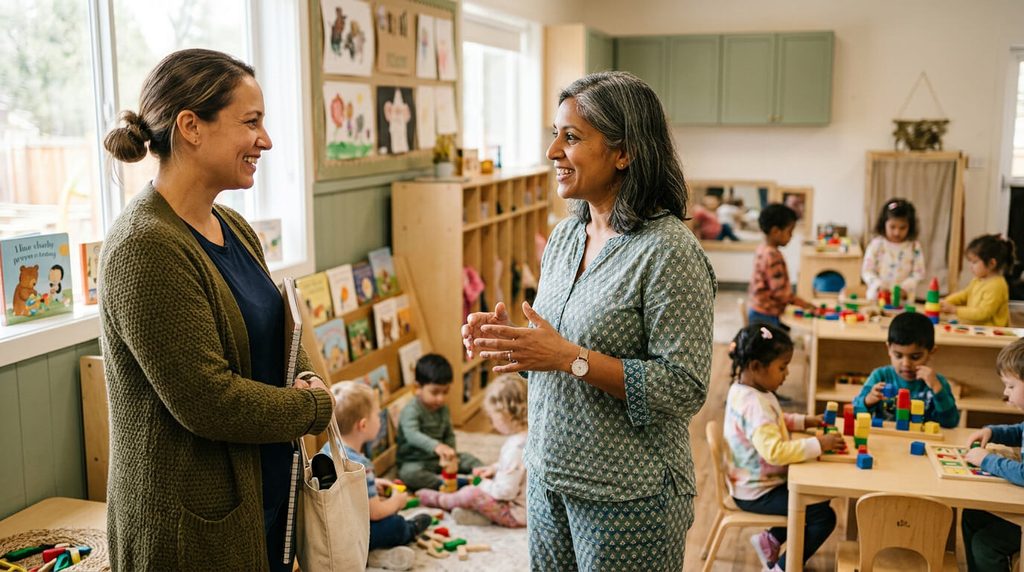
What Should Parents Actually Compare?
Once you understand what type of institution you are considering, move beyond the terminology and look at what happens during an ordinary day.
Start with the teachers. What qualifications and experience do they have? How long have they been working at the school? A stable teaching team can be particularly important for young children, who build trust and security through consistent relationships.
Look at class sizes and adult-to-child ratios as well. A beautifully designed classroom means much less if there are too many children for teachers to give them meaningful individual attention.
Then consider the educational programme. Is there a clear approach to children’s development? How are language, movement, creativity, social skills, independence and early learning supported? Is children’s play treated simply as free time, or is it understood as an important part of how young children learn?
The physical environment matters too. Are children confined to classrooms for most of the day, or do they have genuine opportunities to move, explore and spend time outdoors?
Food, rest arrangements, opening hours, holidays and communication with parents also make a significant difference to everyday family life.
And, of course, the setting needs to suit your child’s age, personality and developmental needs.
These questions will usually tell you far more than whether the sign outside says preschool, nursery, anaokulu, kreş or gündüz bakımevi.
Where Does Sun Preschool Fit?
Sun Preschool is an anaokulu: an early childhood education setting built around children’s learning and development during the years before primary school.
That distinction matters to us because our day is not organised simply around keeping children occupied until their parents arrive.
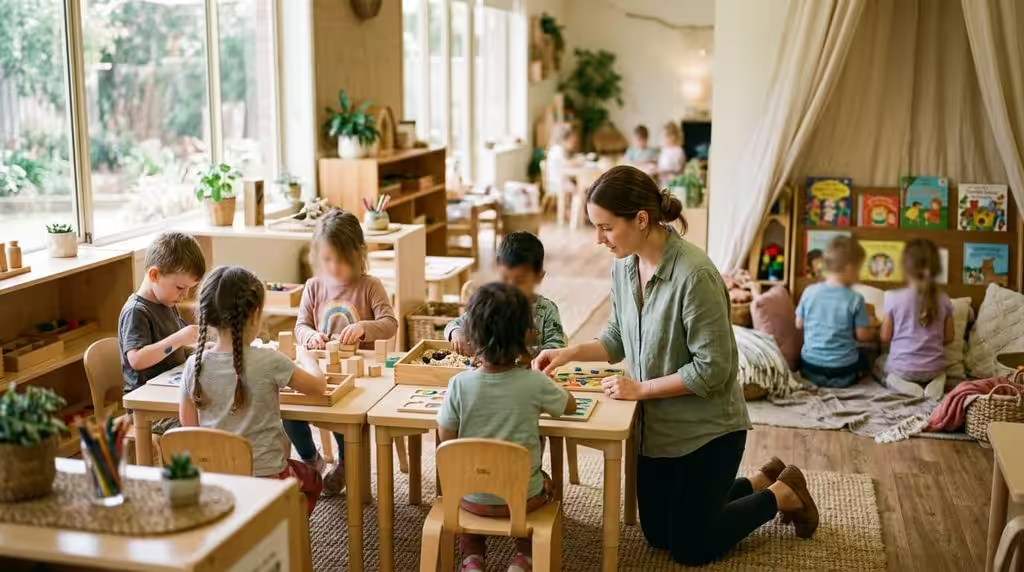
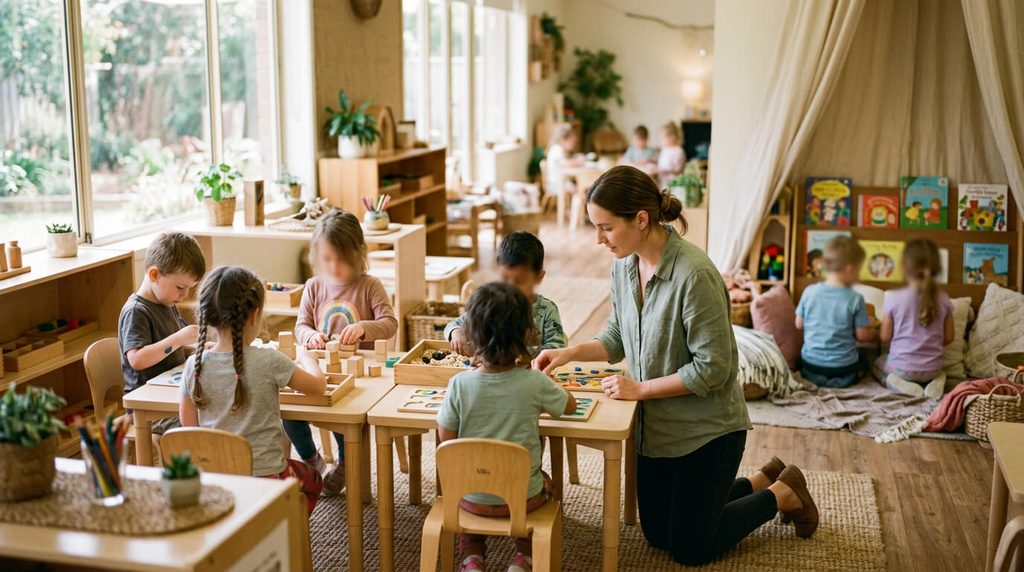
Behind the play, conversations, activities and routines is an educational purpose. Our programme considers children’s social, emotional, cognitive, physical and language development, while allowing them to experience childhood as children should — through play, curiosity, movement, relationships and exploration.
English is integrated into children’s daily school experience rather than treated simply as an occasional lesson. Our aim is for children to encounter and use the language naturally within the rhythm of the school day.
Just as importantly, we place considerable value on continuity in our teaching team, manageable class sizes, genuine outdoor space and the everyday relationships children build with the adults around them.
Care is therefore an essential part of what we do — because meaningful early education cannot exist unless children first feel safe, known and cared for. But the purpose of the school extends beyond care: it is an intentionally designed early learning environment.
The easiest way to understand what that means in practice is to visit. A school tour allows you to see not only the building, but also the atmosphere, the interactions and the small details that are difficult to communicate on a website.
The Takeaway: Understand the Term, Then Look Beyond It
So, what is the difference between a preschool, nursery and day care?
Broadly speaking, preschool tends to emphasise early education, while day care tends to emphasise care, and nursery can mean different things depending on the country and institution.
In Türkiye, anaokulu, kreş and gündüz bakımevi also refer to different types of early years provision and may operate under different regulatory frameworks.
But understanding the terminology is only the first step.
No label can tell you whether teachers are warm and experienced, whether children receive individual attention, whether the programme is developmentally thoughtful, whether the food is good or whether your child will feel happy and secure there.
First understand what kind of institution you are visiting. Then look beyond the name and judge what is actually happening inside it.
If you would like to see how this looks in practice, we would be happy to welcome you to Sun Preschool.
References & Further Reading
- National Association for the Education of Young Children (NAEYC) — The 10 NAEYC Program Standards
Frequently asked questions
Is a *kreş* worse than an *anaokulu*?
Not necessarily — the words describe emphasis, not quality. A kreş traditionally leans towards care and often takes younger children, while an anaokulu leans towards early education, but many nurseries are excellent and some preschools are mediocre. Judge the specific place on its staff, curriculum and warmth, not on the noun above the door.
Does the label tell me anything about quality?
Only a little. It hints at whether a setting emphasises care or education and roughly what ages it serves, but it makes no promises about how good it actually is. Treat the name as a starting point and let a real visit — how the staff talk, how the children seem, how the day is structured — do the actual judging.
Which is right for a working parent who needs long hours?
It depends on your child’s age and your day. Care-focused settings often offer longer hours and take younger children, which can suit a full working day; education-focused preschools may run more school-like hours. Some settings combine both. Be clear about the hours and ages you need, then find the highest-quality option that genuinely fits them.