When choosing a preschool after moving to Istanbul, start with your child’s needs and your family’s daily routine. Try the journey at drop-off and collection times, check how the school supports your child’s languages, and ask about its age groups and registration process. An “international” label alone tells you little about the day ahead.
Alongside setting up a new home, these decisions can feel like a lot to manage. Take them one at a time: the journey, the daily timetable, language and registration.

Start With the Daily Journey
A route that looks short on the map can feel very different at rush hour. Once you know where you’ll live, try the journey to any school you’re considering at roughly the times your child would travel. Talk about who will do the drop-off and pick-up, and who can step in when a working day changes.
Being close isn’t the only thing that matters, but a long, unpredictable commute can make every day more tiring. Compare the school’s hours with your working hours. If you choose a half-day place, work out where your child will spend the afternoon, and with whom.
If you’re looking at options in Bahçeşehir, our local guide to choosing a preschool in Bahçeşehir will help you think about the daily route and the area around each school when you visit. If you’re settling in another part of the city, the same questions apply to your own route. For the questions worth asking at every school, see our checklist for choosing a good preschool. Our comparison of half-day and full-day preschool can help you plan the rest of the day too.
A School’s Licence and Its Teaching Approach Are Different Things
A school using an “international” approach doesn’t, on its own, tell you what kind of licence it holds. Ask directly: which licence does the school operate under, which age groups does it accept, and how does its programme relate to Türkiye’s national curriculum? In Türkiye, preschools are licensed by MEB, the Ministry of National Education.
In the same way, seeing the name of a teaching method doesn’t mean the school holds an independent accreditation for it. “How does this approach show up in the classroom?” is a more concrete question. And for any school that promises English, look at how language is used through the day, not only at where the teachers come from.
It helps to keep the language programme separate from the licence. The school’s official licence, its curriculum approach and its language model answer different questions, so ask for an explanation of each of the three when you meet. For the terms used for different settings, see our guide to preschool, nursery and day care in Türkiye.
Which Age Group Will Your Child Join?
Take your child’s date of birth to the meeting. A class name from another country may not line up neatly with the age groups used in Türkiye. Ask about the preschool’s starting age and how its groups are organised, and keep that separate from the rules for starting primary school.
Our guide to school starting ages in Türkiye explains how age is counted in months here. If your child is close to one of the cut-offs, talk through the options to start early or wait a year with the leadership of the school concerned. Do share what your child could do at their previous school, but don’t expect them to be placed purely on the name of their old class.
How to Weigh Up a School’s Language Model
Tell the school which languages you speak at home and which ones your child is comfortable expressing themselves in. A child who already speaks English may still need support with everyday communication in Turkish at a new school. And for a child whose home language is Turkish, joining in with English is a separate experience of its own.
These questions are worth asking on a visit:
- Who does my child talk to during the day, and in which languages?
- When my child can’t explain what they need in the school’s language, how does an adult help?
- How do the two languages come together in the same activity?
- Which language will you use to keep us informed?
- How do you keep track of my child’s language development?
- How are the first weeks organised for a child who is new?
NAEYC’s guidance on welcoming bilingual children stresses making room for a child’s home language and for what families can tell the school. You don’t need to give up your home language for the school’s.
What to Bring to the Admissions Meeting
Ask the school for a written list of the documents that apply to your child’s situation. It helps to gather a few things in advance: identity documents and details of any previous school, health and allergy information, emergency contacts, and the list of adults authorised to collect your child.
Go through vaccination and health records from abroad with your paediatrician. Ask the school which documents need a Turkish translation or an explanatory note. For anything to do with residence or a foreign national’s ID, check with the school’s management what applies in your case; don’t assume every family needs the same set of documents.
If your phone number or address is changing during the move, pass on the up-to-date details before the first day. It matters to know who can be reached if your child falls ill or needs to be collected early.
A new school’s first job is to build a bridge between the world your child already knows and their new everyday life.
Getting to Know Sun Preschool
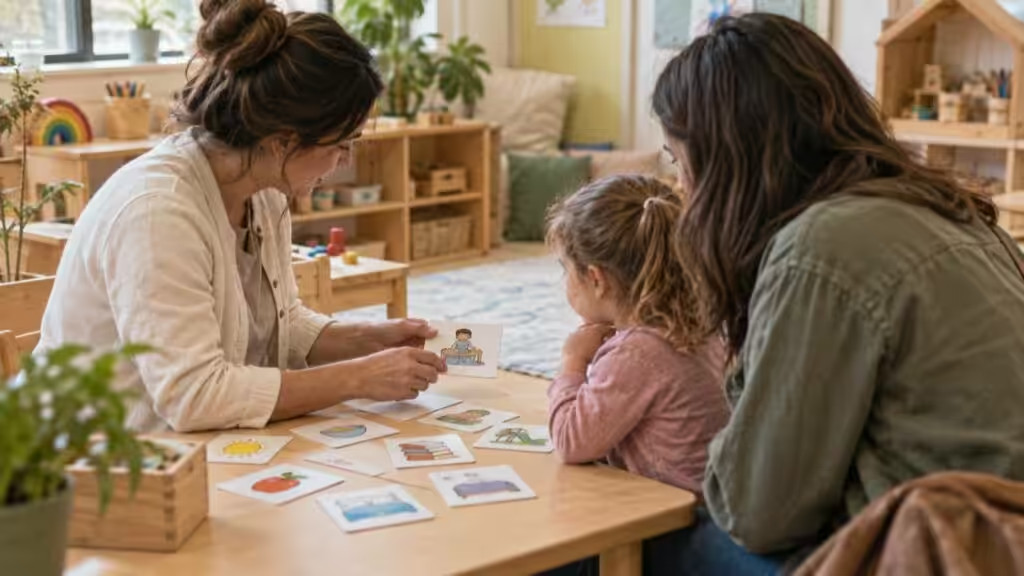
Sun Preschool is in Bahçeşehir, licensed by MEB, for children from 24 months to six years. Turkish and English are both part of everyday life here. Our programme uses a “lead teacher and curious companion” approach: the classroom teacher leads activities, while the English teacher joins in and communicates in English. That’s how the younger groups meet English through the day; separate English lessons start at four, in the Cocoons group (4–5 years), and carry on in the Butterflies (ages 5–6). Our guide to comparing English programmes at preschool explains the daily arrangements in more detail.
When we meet, we can talk about your child’s previous school, the meal and rest routines they’re used to, the languages you speak at home, and the changes your family is going through. Our admissions page is the place to start for the practical side of that meeting.
If you’d like to talk about a good start to your new life here, you can arrange a visit. We’ll sit down together to talk through your questions.
References & Further Reading
- NAEYC (National Association for the Education of Young Children) — Welcoming bilingual children in early childhood settings.
- Ministry of National Education (MEB) — Frequently asked questions on preschool and primary school registration (in Turkish).
Frequently asked questions
Can my child start preschool if they don’t speak Turkish?
Schools differ in their admissions arrangements for children who do not speak Turkish. Talk to the school about its admission conditions and how your child’s needs will be met. In particular, ask how they’ll help your child ask for help and follow the daily routine.
Is a school with an international programme a “foreign school”?
Not necessarily: the two terms don’t mean the same thing. Find out separately what kind of official licence the school holds and how its programme relates to Türkiye’s national framework. A marketing label is no substitute for legal status.
Should our child start as soon as we’ve moved?
It depends on how your family’s routine is settling and how your child tends to react to change. No single waiting period suits everyone. Work out a start with the school that’s predictable and right for your child.