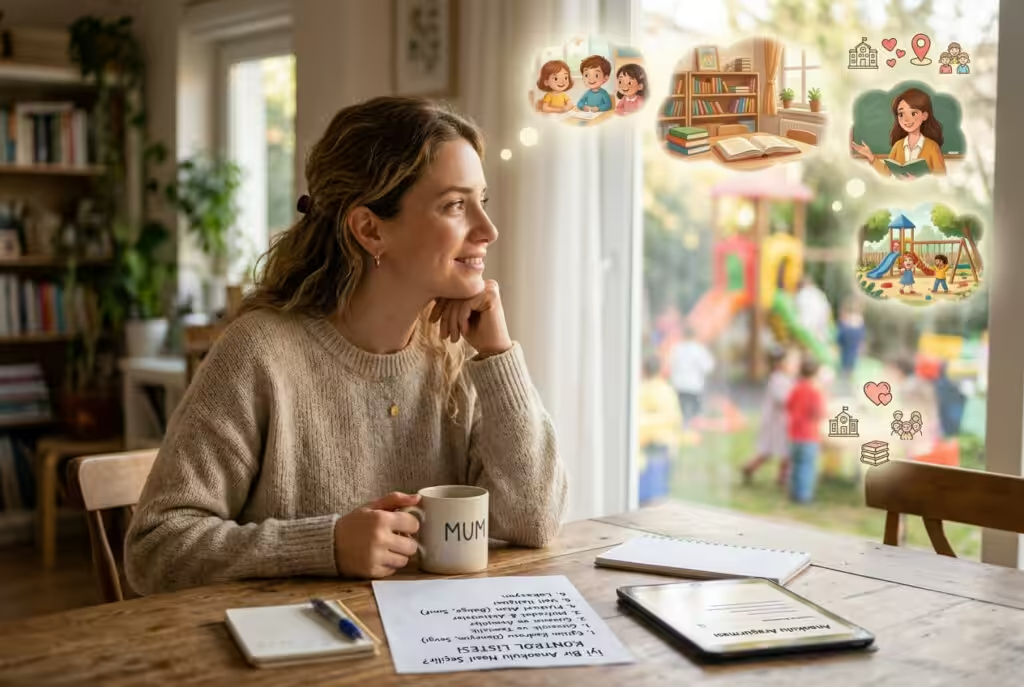
Choosing the right preschool is one of the first big decisions you’ll make about your child’s education — and, let’s be honest, it’s not a simple one. Dozens of options, brochures that all blur into each other, everyone insisting they’re “the best.” Not knowing where to start is completely understandable.
So here’s a practical checklist to help you cut through it. For each point, we explain why it matters and the exact question to ask when you’re standing in the building. The idea isn’t to hand you a verdict — it’s to put the right questions in your pocket so you can reach your own, with confidence.
Staff Continuity and the Quality of the Teachers
What makes a preschool good usually isn’t the building or the brochure — it’s the people. Look at two things together: how good the teachers are, and how long they stay. Where teachers come and go, your child has to build trust from scratch every time, and that quietly eats away at their sense of security.
Ask on your visit: “How long have your teachers typically been here? Do you have people who’ve stayed for many years?”
Class Size and the Teacher-to-Child Ratio
The more children there are per adult, the less of that adult each child gets — and with the youngest ones, that ratio matters enormously. It’s worth looking at how many teachers are in the room, too: with more than one, children get noticed and followed far more closely.
Ask on your visit: “How many children and how many teachers are in a class? And how does that change with the younger age groups?”
Educational Approach and Curriculum
“Play-based.” “Child-centred.” You’ll find those phrases in nearly every brochure going. What counts is whether there’s a real, consistent approach underneath them. Ask what the school’s teaching is actually built on, and how that shows up in an ordinary day.
Ask on your visit: “What’s at the core of your approach? Walk me through a typical day — where would I actually see that approach in action?”
What the Language Teaching Really Looks Like
Among the schools that offer “English” or “bilingual” education, the gap between one and the next is huge. Find out whether the language is a lesson penned into one slot or something the children live through the day. And find out who’s delivering it: it’s not enough to speak the language — you want people who know how to help small children pick it up.
Ask on your visit: “How much of the day are the children actually in English? And what are the people teaching it qualified in?”
The Space and the Outdoors
Children learn on their feet — moving, exploring, getting their hands into the natural world. In a city like Istanbul especially, a real outdoor space — a garden, proper places to play, time spent outside — is worth a great deal. It’s worth noticing the classrooms too: are they light and safe, and do children have room to move freely?
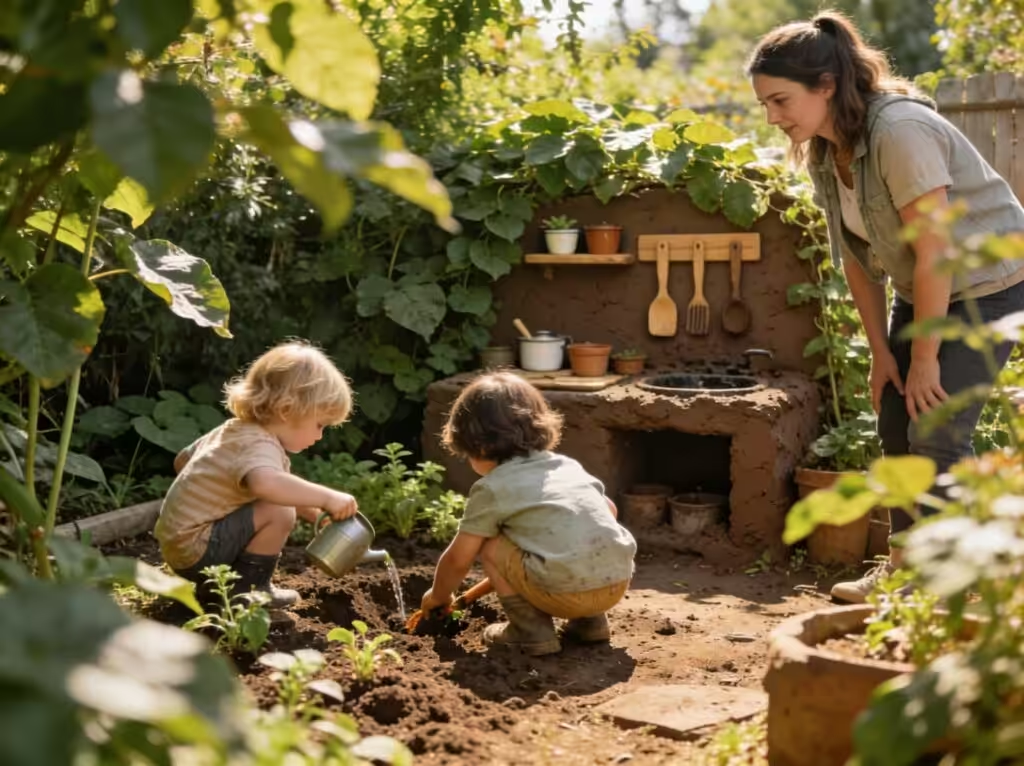
Ask on your visit: “How much time do the children spend outside each day? Could I see the garden and the outdoor space?”
Food and the Kitchen
What a small child eats all day is something most families care deeply about — and rightly so. Ask whether meals are cooked on-site or brought in, what goes into them, and how they handle a child with allergies.
Ask on your visit: “Where and how are the meals made? And what do you do to keep a child with allergies safe?”
Safety and Health
Safety should rest on systems that actually work, not on a polished description. Ask about first-aid training, how drop-off and pick-up are handled (especially who’s allowed to collect a child), what happens in an emergency, and the everyday health routines. A good school will talk you through all of it openly.
Ask on your visit: “How does pick-up work — who can collect my child? Are your staff first-aid trained, and what’s the plan if something goes wrong?”
Communication and Openness
Your child is away from you all day, so how the school keeps you in the loop matters a lot for your own peace of mind. Daily updates on meals, sleep, and activities, regular word on how they’re developing, and a genuine openness to your questions are the backbone of a healthy relationship between home and school.
Ask on your visit: “How, and how often, will you update me about my child’s day? How do you usually keep in touch with families?”
Above All: Go and See for Yourself
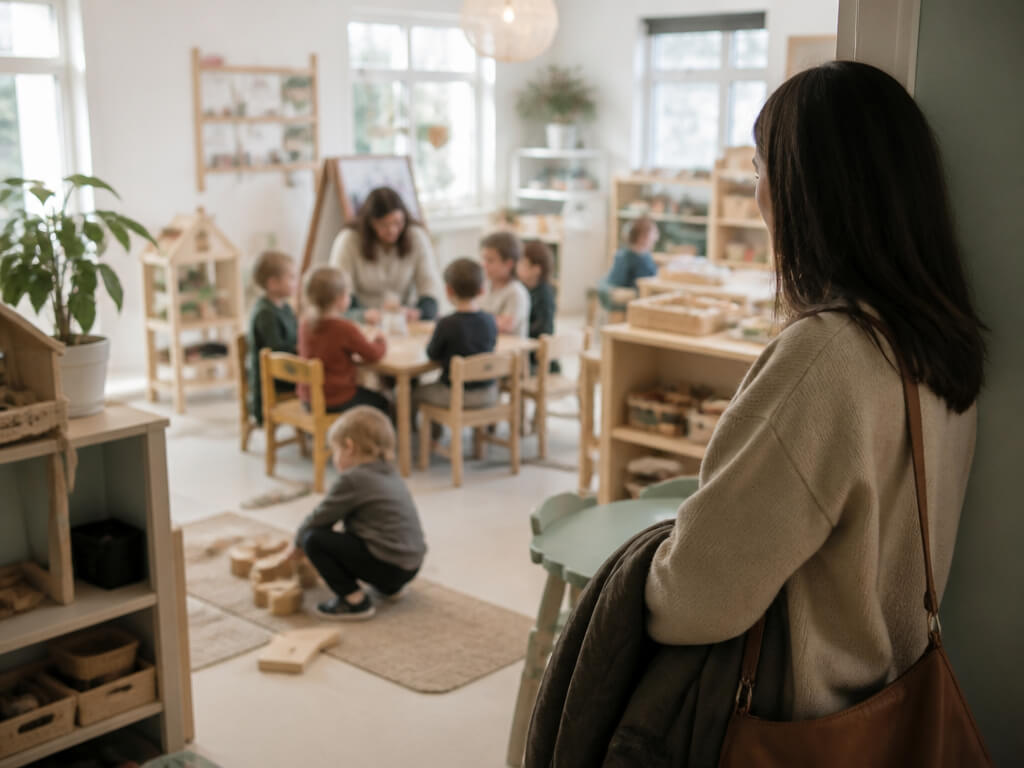
No brochure, website, or phone call can stand in for walking through the door. You only really feel a school once you’re inside it. When you visit, watch for the things a leaflet can’t tell you: do the children seem happy and relaxed? How do the teachers talk to them — warmly, respectfully? Does the place feel safe and cared-for? Can you picture yourself leaving your child here and driving off with an easy mind?
Trust your instincts. The warmth and reassurance you feel in a good school are often every bit as telling as the items on any checklist.
The warmth you feel the moment you walk in is data too — trust it alongside the checklist.
So, Where Does Sun Preschool Fit In?
Honestly, this checklist more or less describes the standards we’ve held ourselves to for years: a settled, experienced team; English that’s lived through the day rather than timetabled; a curriculum with real thinking behind it; a big garden that keeps children close to nature; fresh meals cooked in our own kitchen; careful, sensible safety; and open, steady contact with families.
But the honest thing isn’t for us to tell you all that — it’s for you to come and see it. Which is exactly why we’d love to have you visit.
The Takeaway: The Right Questions, and the Confidence to Decide
Choosing a good preschool is less about ticking off a long list than about asking good questions and paying attention to how a place feels once you’re in it. Use the points above as a compass, visit a few, and listen to your head and your gut in equal measure.
If you’d like to hold Sun Preschool up against this list, come and tour the campus and ask us anything, in person. We’d be delighted to welcome you and your child.
References & Further Reading
- National Association for the Education of Young Children (NAEYC) — The 10 NAEYC Program Standards
- NAEYC — Staff-to-Child Ratio and Class Size
Frequently asked questions
Can we visit the school before enrolling?
Of course — we would be delighted to welcome you before you enroll.
Because our children’s safety and privacy come first, we don’t admit anyone other than staff into the classrooms and children’s areas during school hours. For that reason, we hold our school tours after 17:00, when you can explore every space at ease.
During the day, you are always welcome to visit by appointment and talk through our educational approach over tea or coffee. Our door is open.
What educational approach do you follow?
Our education rests on a four-layer curriculum in which each layer strengthens the others.
- Foundation: The Turkish Ministry of Education’s Türkiye Century Education Model frames all of our planning.
- Language: English is lived as part of the natural flow of the day rather than taught as a separate lesson; our English teachers are part of the day from start to finish.
- Science and discovery: With the UC Berkeley–rooted GEMS program, children enjoy playful, inquiry-based experiences in science and mathematics.
- World-class methods: We draw on Montessori (prepared environment and independence), Reggio Emilia (documentation that makes learning visible), and Forest School (discovery in nature).
In the child’s day, all of these come together as one meaningful, integrated experience — never a confusing patchwork.
How does the enrollment process work?
Enrollment starts with a short introductory meeting and follows five simple steps.
- Meet: We get to know you and your child in a brief conversation.
- School tour: You visit our school and we answer all your questions in person.
- Application: You complete a short application form.
- Assessment: We spend time with your child to find the group that suits them best.
- Enrollment: If a place is available, we complete the registration.
There is no pressure at any step — our goal is for your family to make the right decision comfortably.
What’s the ideal student-to-teacher ratio for a preschooler?
For this age, look for small groups with more than one adult in the room. NAEYC — a leading early-education body — recommends no more than about ten preschoolers per teacher (and fewer is better), with two teaching staff in the classroom. State or local minimums are often looser than this, so ask for the *actual* ratio in your child’s room, not just the legal minimum.
How do you vet your kitchen staff and ingredients?
Ask any school exactly this. A strong answer covers where meals are cooked (ideally on-site), how fresh the ingredients are, how allergies are tracked and cross-checked, and what training and health checks the kitchen team has. If a school can walk you through its food process in detail, that specificity is itself a good sign.
Can I visit your school on a normal school day, not just during an open house?
Yes — and you should want to. A staged open house shows a school at its most polished; an ordinary weekday shows you how it really runs. A confident, transparent preschool will welcome a visit during regular hours so you can see the classrooms, the garden, and the teachers in action.