“My child will hear English throughout the day, but what will they actually gain?” Regular conversation gives children opportunities to become familiar with English sounds, use words for a purpose and try communicating in another language. Starting early doesn’t, by itself, guarantee fluent speech, a particular accent or higher intelligence.
Remembering a song, understanding a request and choosing a word during play are different achievements. This guide considers realistic benefits and the conditions that support them.
What Does the Research Support?
Özpolat and Sağlam’s study in the Journal of Early Childhood Studies used the Turkish Early Language Development Test (TEDİL) with 120 children aged 2–7. It found no statistically significant difference in receptive and expressive language skills between the bilingual and monolingual groups. The finding concerns those groups, not a particular preschool programme or every child’s likely outcome.
Becoming Familiar With Speech Sounds
In Kuhl, Tsao and Liu’s study of infants, babies who heard another language through live interaction learned to distinguish its speech sounds. Babies exposed to the same speakers and materials through video or audio recordings did not show that effect. The study highlights interpersonal interaction; it did not measure preschoolers’ conversational fluency or future accents.
Recognising a sound, saying a word and keeping a conversation going are different skills. Regular opportunities to hear and use English can support pronunciation development, but they cannot guarantee a particular accent. Our guide to when and how to start English explores how those early experiences can be organised.
Looking at the Whole Language Picture
ASHA’s guidance for families explains that learning more than one language does not itself cause confusion or language delay. Broad language milestones generally follow similar timelines. Even so, a clear communication difficulty shouldn’t be dismissed simply because a child hears two languages.
Vocabulary can be distributed across languages: a child may know words for home experiences in one and words for other experiences in another. Counting only their English words misses part of the picture. Using words from both languages in a conversation is not, on its own, evidence of confusion. These observations concern children growing up with multiple languages; they shouldn’t be applied automatically to every child attending occasional English activities.
If Turkish development is your main concern, our guide to early English and Turkish discusses that question separately. The aim is to widen opportunities for understanding and expression while keeping the child’s home language strong.
Feeling Able to Join In
A reasonable aim is for a child to find ways to participate when they encounter English. Pointing to a requested animal in a book, joining a familiar game or trying a word to ask for something are examples you might discuss with a teacher. They aren’t a checklist every child must complete in the same order.
Greater comfort in one language needn’t mean rejecting another. Switching languages or reaching for a familiar word can be part of communicating. Having someone interested in what they mean matters more than performing for visitors.
Which Claims Deserve Caution?
“Bilingual children are smarter” and “They always have better attention” are unreliable promises on which to choose a school. De Bruin, Treccani and Della Sala’s study of publication bias found that results supporting a cognitive advantage were more likely to be published than results challenging it. Findings do not all point one way, and published research may not represent them evenly.
Communicating in another language is a worthwhile achievement in itself. It doesn’t justify guarantees about intelligence, attention or academic success.
Expectations also need to fit the amount of contact. Hearing an occasional English song is different from using the language in everyday exchanges. A few familiar words don’t demonstrate broad conversational ability. When a school says it offers English, ask what children actually do during the day.
What Helps the Benefits Develop?
Regular contact, responsive interaction and opportunities to participate belong together. Byers-Heinlein and Lew-Williams’ review of early bilingual development draws attention to the quality and quantity of language experience and the need for continued use. An early start doesn’t remove that need later on.
These ideas suggest practical questions for a school visit:
- During which games and routines do children hear English?
- How does the adult respond to something a child points out or starts playing with?
- How can a child participate before they want to speak?
- How does the teacher distinguish remembered words from examples of understanding and communication?
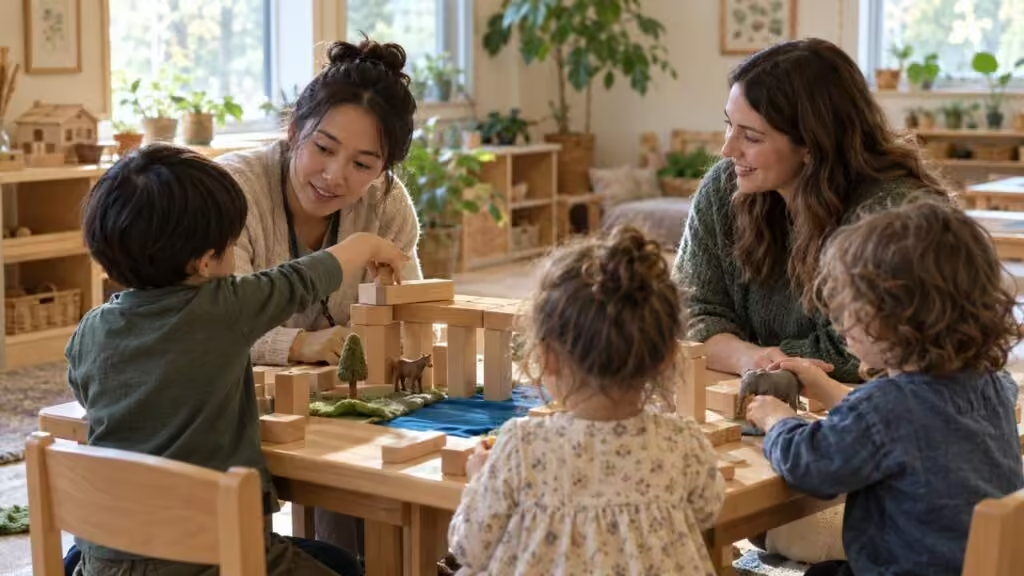
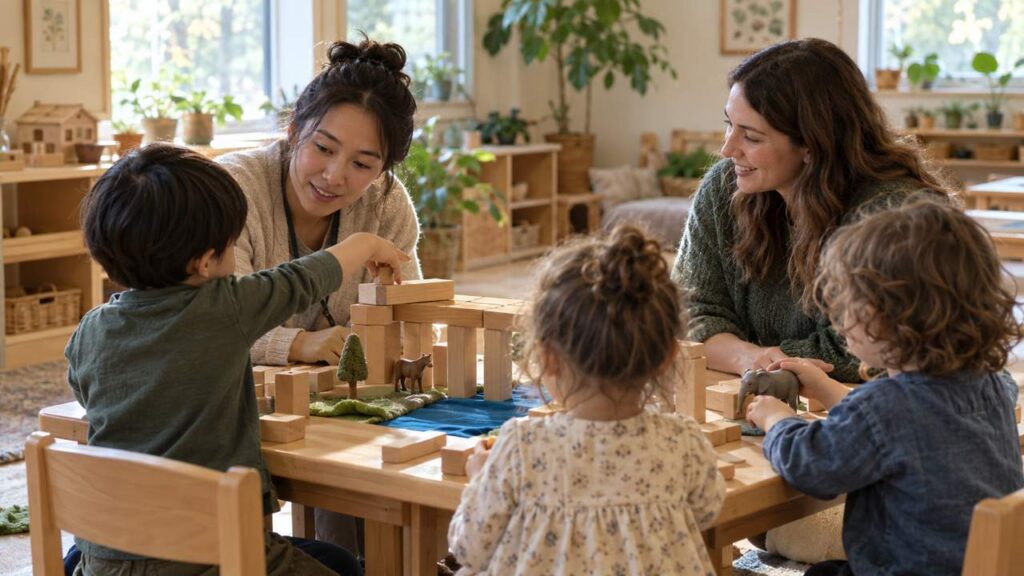
Asking for a block while building a toy bridge gives a word an immediate purpose. Sharing a picture book lets the adult pause over the child’s chosen picture and wait for a response. These are illustrations of responsive interaction, not promises of a particular result. A screen playing in the background shouldn’t be counted as equivalent conversation.

Keep using the language you speak comfortably at home. There’s no need to reduce family conversation to memorised English phrases: leave room for stories, questions and talking about the day. Our guide to supporting English at home offers practical ideas. If you’re comparing school types, our international-school and English-focused programme guide addresses that separate decision.
Look beyond the words a child can perform: ask what they use language to understand or express.
English at Sun Preschool
Sun Preschool has been in Bahçeşehir since 1995 and welcomes children from 24 months to 6 years across four groups. Every class has 2 teachers: the classroom teacher who leads the day and an English teacher alongside the class all day. Children hear and use English through play, activities and everyday routines.
Tiny Caterpillars (ages 2–3) and Caterpillars (ages 3–4) have no separate English lessons. Cocoons (ages 4–5) and Butterflies (ages 5–6) also have separate English lessons. You can explore this arrangement on our curriculum page. It describes the opportunities available, without guaranteeing a language level within a set period.
Base Expectations on Everyday Experience
Alongside “How quickly will my child speak English?”, ask “Who will they communicate with, and when?” Asking a teacher for examples from particular games or observations can tell you more than a general reassurance that things are going well.
A good start can be valuable; further learning depends on interest, use and fresh opportunities. Consider your child’s experience rather than comparing children. For other school-choice questions, return to our parent guide.
References & Further Reading
- Özpolat, M. and Sağlam, M. — Early bilingualism and receptive and expressive language development, Journal of Early Childhood Studies (in Turkish).
- Byers-Heinlein, K. and Lew-Williams, C. — Bilingualism in the early years: what the science says.
- Kuhl, P. K., Tsao, F.-M. and Liu, H.-M. — Foreign-language experience in infancy: phonetic learning and social interaction.
- de Bruin, A., Treccani, B. and Della Sala, S. — Cognitive advantage in bilingualism: an example of publication bias?.
- ASHA — Learning more than one language.
Frequently asked questions
Will an English-intensive preschool make my child more intelligent?
No such guarantee can be made. Research findings on cognitive advantages are mixed and can be affected by publication bias. Judge a programme by its opportunities for communication rather than promises about intelligence.
What everyday examples can show progress in English?
Ask what your child understands and when they communicate spontaneously. Responding to a familiar request or trying a word during play are examples worth discussing. Avoid judging progress by a single performance or word count.
Will my child forget their English if they stop using it after preschool?
Maintaining and developing language skills depends on continued opportunities to hear and use the language. Starting early doesn’t guarantee lasting proficiency. There is no single timescale or outcome that applies to every child.